


Asthma Canada, in partnership with the Canadian Allergy, Asthma and Immunology Foundation (CAAIF), is proud to announce the 2026 recipients of the Graduate Student Research Awards in Asthma.
Together, each year, Asthma Canada and CAAIF provide up to $90,000 in research awards to support graduate students conducting research in the field of asthma.
The Graduate Student Research Awards in Asthma support full-time MSc and PhD students and are intended to foster the next generation of asthma researchers. The awards create opportunities for training, education and professional development, while supporting research into the causes and mechanisms of asthma with the goal of improving treatments and contributing to a future cure.
2026 Award Recipients & Their Research Projects:
Abigail Davis
PhD Student at Queen’s University
Research Project: Tezepelumab in the treatment of co-morbid allergic rhinitis and allergic asthma study (TEZARS) – An Open-Label Exploratory Mechanistic Pilot study to evaluate tezepelumab efficacy in asthma and allergic rhinitis
About Abigail & Their Research Project
2026 Recipient, Graduate Student Research Award, PhD Abigail Davis Queen’s University | Biography: Abigail Davis developed her passion for translational allergy research through an undergraduate research project in the Life Sciences BScH program at Queen’s University. During her final year, she began working with Dr. Anne Ellis, whose mentorship inspired her to pursue graduate studies. As her research evolved, she completed a mini-master’s defense and was promoted directly into the PhD program. Abigail is now a PhD candidate in Dr. Anne Ellis’s laboratory and a trainee in Queen’s University’s Translational Medicine graduate program, where she investigates the relationship between allergic rhinitis and asthma. Her research focuses on understanding allergic rhinitis and asthma mechanisms and evaluating novel therapeutic strategies to improve patient outcomes. Recognized through competitive awards, including the Canada Graduate Research Scholarship–Doctoral (CGRS-D) and the Ontario Graduate Scholarship (OGS), Abigail aims to pursue a career in clinical research advancing innovative therapies for allergic and respiratory diseases. |

Research Project: Tezepelumab in the treatment of co-morbid allergic rhinitis and allergic asthma study (TEZARS) – An Open-Label Exploratory Mechanistic Pilot study to evaluate tezepelumab efficacy in asthma and allergic rhinitis
Allergic rhinitis (AR), commonly known as hay fever, affects up to 80% of people with asthma. Both conditions occur when the immune system overreacts to allergens such as pollen and dust mites. When allergens are inhaled, cells in the nose and lungs release TSLP, a protein that acts like an alarm, triggering immune responses that lead to inflammation. This inflammation causes symptoms including sneezing, nasal congestion, coughing, and wheezing.
Tezepelumab is a medication approved in Canada for the treatment of severe asthma that works by blocking TSLP. Many people with asthma also have AR and higher levels of TSLP in their noses, yet tezepelumab is not approved to treat both conditions due to limited research on its effects on nasal symptoms. We hypothesize tezepelumab will improve both asthma and AR by reducing upper and lower airway inflammation and symptoms.
In this study, 14 participants with both AR and asthma will receive tezepelumab for 12 months. A Nasal Allergen Challenge will be used to trigger an allergic response by applying allergen directly into the nose. Before treatment, and again after 6 and 12 months, we will evaluate nasal symptoms, measure TSLP and other inflammatory markers, assess lung function, and collect quality-of-life information.
This study addresses an important yet understudied patient population. Findings will improve our understanding of TSLP in AR and may support future clinical trials investigating tezepelumab as a treatment for both asthma and AR.
Shuqi Cai
PhD Student at Queen’s University
Research Project: Airway Neural Remodeling Drives iBALT Formation in Allergic Asthma
About Shuqi & Their Research Project
2026 Recipient, Graduate Student Research Award, PhD Shuqi Cai Queen’s University | Biography: Shuqi Cai is a PhD student in Biomedical and Molecular Sciences at Queen’s University, where she works under the supervision of Dr. Sebastien Talbot. Her research focuses on how interactions between the nervous and immune systems contribute to chronic allergic asthma and how these mechanisms might be targeted to develop new therapies. After graduating with a bachelor’s degree in clinical medicine, she pursued research in cancer neuroimmunology during her master’s training, where she became fascinated by the complex interactions between the nervous and immune systems. She enjoys combining advanced imaging and spatial transcriptomic approaches to better understand how immune responses are organized within tissues. Through her PhD, Shuqi hopes to build a career in translational immunology, connecting fundamental discoveries with new treatments that improve the lives of people living with asthma and other chronic inflammatory diseases. |

Research Project: Airway Neural Remodeling Drives iBALT Formation in Allergic Asthma.
Asthma affects millions of people worldwide, and many patients continue to experience symptoms that return even after the allergen that first triggered them is gone. This suggests the lungs retain a form of immune memory that keeps them primed to react to future exposures.
This project asks whether airway nerves help create that memory. In people with asthma, nerves in the lungs increase in number and change in structure after repeated allergen exposure. The goal is to determine whether these altered nerves promote the formation of small immune cell clusters, called inducible Bronchus-Associated Lymphoid Tissue (iBALT), that may act as sites keeping allergic inflammation active long after the initial trigger has cleared.
Using mouse models of asthma, three-dimensional imaging, and spatial gene analysis, this project will examine how nerves and immune cells interact during allergic inflammation. It will also test whether blocking specific nerve signals prevents iBALT from forming, which would help clarify whether nerve activity is required to sustain these immune cell clusters.
If successful, this work will identify a previously unrecognized connection between the nervous and immune systems in asthma. Clarifying how nerves contribute to persistent inflammation could point toward new treatment strategies for patients with severe asthma who do not respond well to existing medications, improving long-term disease control.
Max Housefather
MSc Student at Queen’s University
Research Project: Investigating Macrophage Paralysis and Neutrophilic Inflammation as Mechanisms of Asthma Exacerbation by Wildfire Smoke
About Max & Their Research Project
2026 Recipient, Graduate Student Research Award, MSc Max Housefather Queen’s University | Biography: Max Housefather is an immunology researcher in the Department of Biomedical and Molecular Sciences at Queen’s University. Currently completing a Master of Science under the supervision of Dr. Paul Kubes, he is using cutting-edge imaging techniques to study the lung immune response to wildfire smoke. Max obtained a BHScH with distinction from Queen’s University. During this time, he completed an Honours Thesis investigating the impact of A. fumigatus on stem and immune cell dynamics, and served as a Teaching Assistant for the Queen’s Infection, Immunity, and Inflammation course. With the support of Asthma Canada and CAAIF, he hopes to uncover new mechanisms of asthma exacerbation by wildfire smoke, leading to improved treatments and outcomes for people with asthma affected by wildfires. |

Research Project: Investigating Macrophage Paralysis and Neutrophilic Inflammation as Mechanisms of Asthma Exacerbation by Wildfire Smoke
Wildfires are becoming increasingly severe, and the smoke they produce is particularly harmful for people with asthma. However, how wildfire smoke exacerbates asthma is unclear. To answer this question, we will deliver wildfire smoke particles to mice and use special microscopes to observe their real-time effects on immune cells in the lung. We will first determine if wildfire smoke impairs macrophages—immune cells responsible for clearing any noxious substances we breath in. We will then test whether wildfire smoke increases neutrophils (inflammatory cells) in the lung, and whether this worsens asthma and makes it harder to treat. Ultimately, our findings could inform future treatment options for asthma exacerbated by wildfire smoke, and potentially other forms of treatment-resistant asthma.
Austin Pozniak
MSc Student at Guelph University
Research Project: Defining a Non-Allergic Mast Cell-Mediated Neuroimmune Axis in Asthma
About Austin Pozniak & Their Research Project
2026 Recipient, Graduate Student Research Award, MSc Austin Pozniak Guelph University | Biography: Austin Pozniak completed his undergraduate degree at the University of Guelph, studying Biomedical Science and Microbiology. He then began his MSc degree in the Department of Molecular and Cellular Biology at the University of Guelph under the supervision of Dr. Priyanka Pundir, studying the role of mast cells in infectious and inflammatory diseases. He has always been interested in the biological sciences and is specifically interested in the translation of medical research between humans and other species. Austin looks forward to continuing his studies with a One Health perspective, including understanding how diseases that are shared by different species exhibit similar pathophysiology and how this can be used in both research and therapeutic contexts. |
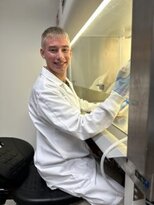
Research Project: Defining a Non-Allergic Mast Cell-Mediated Neuroimmune Axis in Asthma
Asthma is an inflammatory airway disease that often causes symptoms such as coughing, wheezing, and shortness of breath. While asthma is classically considered an allergic disease, there are also non-allergic mechanisms that play a role. Mast cells and sensory neurons are two cell types found within the airways that can communicate with each other to promote airway inflammation. Mast cells express a surface protein that can detect molecules released by neurons and promote the onset of inflammation, and it has been shown that there is increased expression of this protein in asthmatic lung tissue. This project aims to understand the role of mast cell expressed surface proteins in the onset and maintenance of airway inflammation in asthma, independent of the traditional allergic context. Specifically, we will focus on how sensory neurons activate mast cells to promote the release of molecules that contribute to disease development. By increasing our understanding of how this receptor may promote asthma, this will allow us to potentially harness receptor inhibitors as a future therapeutic option for asthma patients.
The Future of Asthma Research
Research is essential to improving our understanding of asthma and finding better ways to prevent, manage and treat the disease. By supporting graduate students at an early stage in their research careers, these awards help build the next generation of researchers working to improve the lives of people living with asthma.
Congratulations to Abigail, Shuqi, Max and Austin on receiving the 2026 Graduate Student Research Awards in Asthma.
Learn more about the Graduate Student Research Awards and Asthma Canada’s research initiatives:
Support Canadian Asthma Research
Your support can help advance research that brings us closer to better treatments and, one day, a cure for asthma.
By supporting Asthma Canada’s Research Program, you’re helping fund the next generation of asthma researchers and research that could make a real difference for people living with asthma.


